
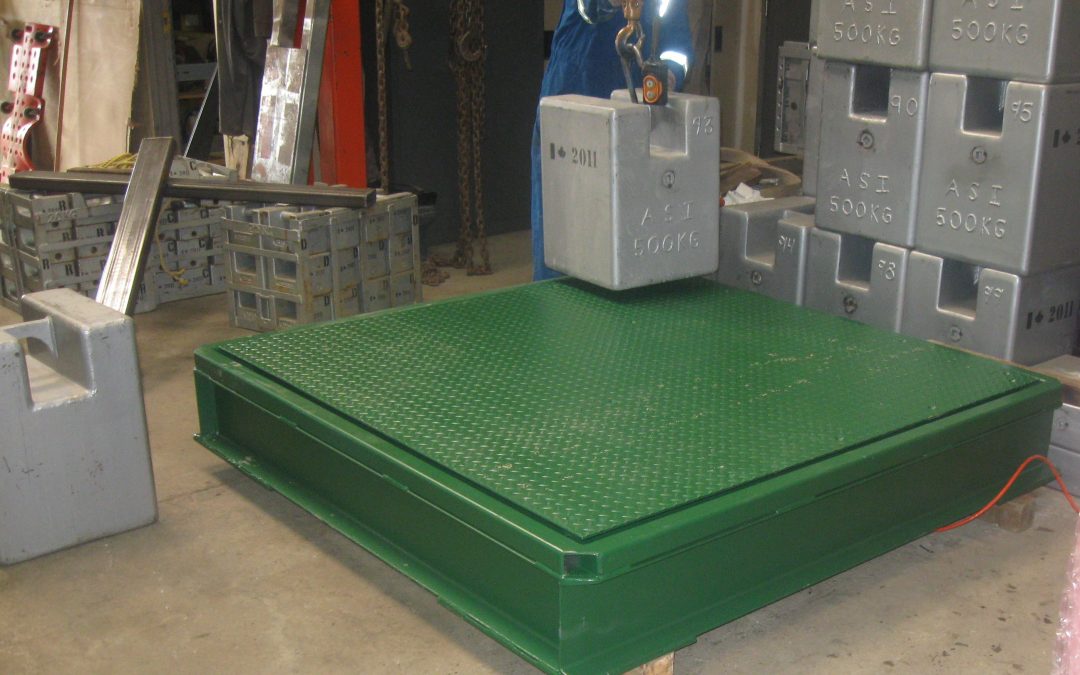
Wondering if your floor scale is still up to par for your business? Thinking it may be time to size up, or down, for your job site? While floor scales are highly versatile weighing devices for industries throughout Western Canada, they aren’t always the ideal fit for every project or worksite.
Below, let’s explore when a floor scale is well-suited to tasks, and when it may be worth considering other options. Read on!
What Floor Scales Are Best Suited For
Whether weighing drums, factory equipment, or pallets, floor scales are built to weigh the largest items with ease.Floor scales have a substantial capacity, with many of the heaviest-duty models capable of accurately weighing loads up to 80,000 lbs.
As we’ve discussed before, floor scales provide hefty support for smaller loads such as tote bags, drums of liquid, banded boxes of finished goods, and pallets coming off a forklift. Many models feature flat, ground-level decks, allowing operators to roll a pallet jack straight onto the platform with minimal lifting. The wide footprint keeps the load stable while the indicator settles on a final reading.
When to Go Smaller
While floor scales are certainly useful devices, not all jobs require such a high capacity. If you’re routinely only measuring loads under 1,000 lbs, a floor scale may not be worth the investment or footprint. For these situations, a high-quality bench or platform scale may be all that’s required for daily weighing.
If your loads look like this, you may need to go smaller:
- Small parts coming off a production line, where each item weighs under 50 lbs, and a four-foot platform is more space than the job needs
- Quality-control checks for bins of bolts, fittings, and other fabrications, where each container is no more than several hundred pounds.
- Boxes for shipping and receiving in the 50 to 500 lb range, where a bench scale fits on a counter and saves the floor space
When to Go Bigger
When some mismatches can be solved by minimizing, others are solved by going the other way—bigger! If you’re looking for a solution with a capacity above 10,000 lbs, it may be worth considering a size-up. Some options include pit scales that are installed in the ground and heavier-duty floor scales with higher capacities.
If your loads look like this, you may need to go bigger:
- Pallets of dense material like steel plate, lumber stacks, or bagged concrete that easily push past the 10,000 lb mark
- Bulk drums, totes, or super-sacks of grain or chemicals filled and weighed for inventory or shipping
- Equipment, machinery, or vehicles being weighed for transport quotes or load planning before they leave the yard
Knowing whether a floor scale is right for you comes down to understanding capacity. Floor scales have among the largest capacities of commercially available industrial scales. Options like Accurate Scale’s Extreme-Duty Platform Scaleare built to rugged, rigorous standards, with reinforced frames and high-capacity load cells designed for years of heavy industrial use.
Choosing the Right Scale for Your Workflow
Finding the right industrial scale for your operation can feel a bit like Goldilocks. Too big and you risk losing accuracy on lighter loads and over-investing in capacity. Too small, and you risk overloading the scale and causing damage. Instead, you want a scale that’s appropriately sized for the job.
It’s always a good idea to work with a professional scale specialist when deciding on the right weighing setup. At Accurate Scale, we carry a wide range of commercial scales, many of which can be certified for Legal-For-Trade use.
Confidently Weigh with Accurate Scale
Accurate Scale is Western Canada’s chosen scale supplier, providing reliable weighing solutions to support operations. Visit our Edmonton location or contact us today to inquire about a high-quality, powerful scale for your operation.