
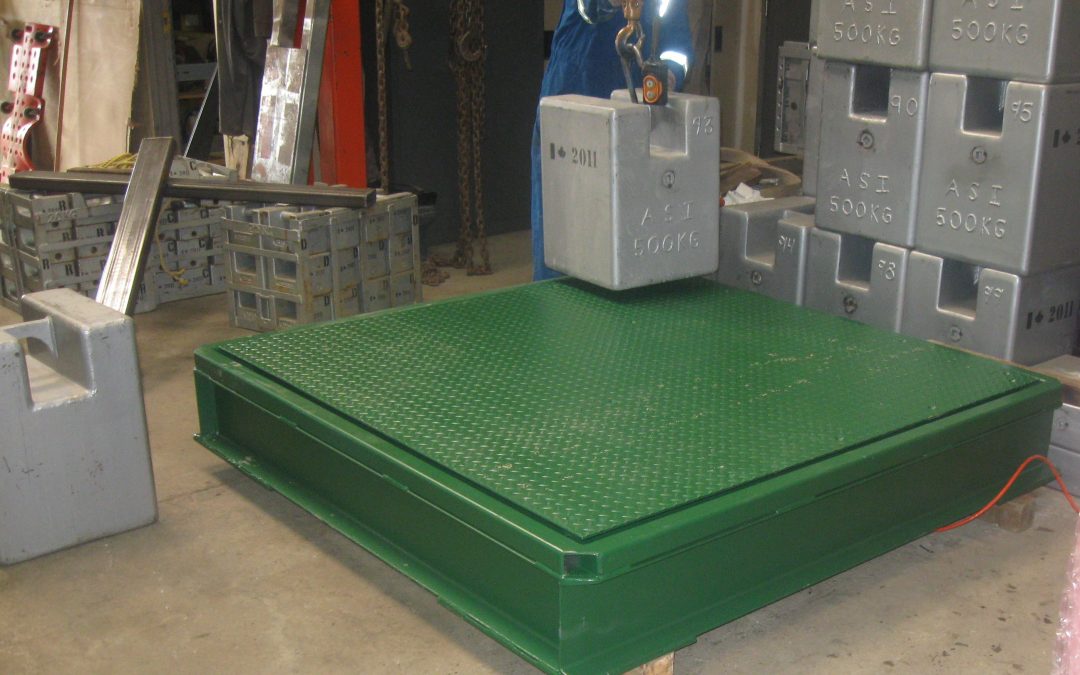
Are you in the market for a reliable, precise floor scale for your day-to-day industrial operations? Whether you’re looking to replace an older unit or purchase your first floor scale, choosing the right model is crucial for long-term performance.
In this short blog with Accurate Scale, let’s explore the ins and outs of choosing a reliable floor scale. For nearly 50 years, Accurate Scale has been manufacturing and supplying scales for industrial businesses across the Canadian prairies. Read on to learn with us below.
Understand Your Capacity & Usage
Capacity is key and a necessary guideline to ensure your scale can accurately measure your load with ease. Floor scales are among the most widely used industrial scales, with a wide range of applications across Canada. They also offer high-capacity measurements, with some of the heaviest-duty models able to weigh substantial loads up to 80,000lbs.
What’s the average load size you’re expecting to need to measure, and what’s the maximum? A floor scale should be based not only on your typical loads, but the largest. Keep in mind that if you occasionally need to measure a load of roughly 35,000 lbs, a scale with a 10,000 lb capacity won’t be enough—even if it’s the average you’ll be measuring. Otherwise, you open yourself up to the risk of damage and incorrect readings. Additionally, consider platform size. Ensure the platform is large enough to support your typical loads with minimal overhang.
Lastly, it’s crucial to consider not only current capacity needs but also future measurement needs. While future-proofing to complete certainty isn’t always possible, taking future goals into account may help you avoid upgrading sooner than expected.
Location Matters
Where your floor scale will be located is just as important as the scale itself. A floor scale located on an outdoor loading dock will face different environmental demands than one located in a climate-controlled warehouse year-round. While exposure to dirt, debris, and contaminants can affect floor scale longevity, many of these risks can be mitigated by selecting the right scale and protection.
For example, consider IP (ingress protection) to ensure the floor scale meets your required standards. Some accessories can help protect your floor scale, such as cable protection conduits for wires and ramps to protect platform edges.
Indicators and Ease of Use
A simple-to-use floor scale can be the difference between a smooth daily workflow and unnecessary slowdowns. As a result, it’s crucial to consider how the scale will be integrated into daily routines. Who will be using the floor scale? How will loads be placed and removed from the platform? Will these measurements need to be recorded anywhere else, or are they for internal reference only? Functionality is key to maintaining productivity day in and day out.
The indicator, for example, plays a central role in ensuring usability. Ensure the floor scale has a clear, easy-to-read display that’s large enough to be seen during operation. Beyond readability, ensure the scale has core functions that operators can use. This includes essential weighing features, such as the ‘tare’ function.
It’s also essential to consider how the scale will integrate into your existing operation. A floor scale should be an asset to your operation, not slow it down. If necessary, ensure that the indicator can sufficiently connect to your current systems to record measurements efficiently.
Ready to Amp Up Your Accuracy?
A properly chosen floor scale can help your business remain precise and compliant for years to come. Visit our Edmonton location or reach out to us today to receive personalized support on finding the right weighing solution for your Canadian business.