
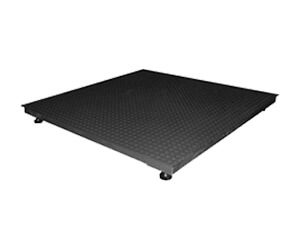
From regional airports to packaging facilities, industries worldwide rely on floor scales to ensure consistent weighing. These robust industrial scales deliver some of the highest capacities available, with many options capable of measuring up to tens of thousands of pounds.
Read along with us here at Accurate Scale, as we explore how to keep your floor scale performing as accurately as possible. We’re one of Western Canada’s largest industrial-scale suppliers, helping businesses maintain weighing compliance every day.
#1: Calibration, Calibration, Calibration
Like any scale, floor scales must be calibrated periodically to maintain full accuracy and efficiency. Calibration is essential not only for accuracy, but also to maintain legal for trade certification and compliance. Make sure that a professional scale technician performs the calibration. Unlike bench scales and other smaller scale varieties, floor scales require substantially larger test weights. Attempting to calibrate a floor scale without the proper equipment and expertise can result in unreliable results.
That’s why at Accurate Scale, we offer on-site comprehensive scale calibration services for heavy-duty floor scales. We’ll make our way to your facility and calibrate it using a series of government-tested weights.
#2: Keep It Level
An uneven or unlevel floor scale can lead to inaccurate readings. To prevent this, keep floor scales on a level, even surface. All four of its feet, or its entire base, should stay firmly fixed to the ground. But if the scale’s feet become damaged or chipped, or if the ground shifts, the scale won’t be level. Moving your floor scale, even a few feet, often means it will no longer be level.
Regularly check if your floor scale is level. Some floor scales have a built-in level within the frame, but others require a manual measurement. Simply take a carpenter’s level and place it on the platform’s surface. Make sure it’s level from all directions, including front to back, side to side, and corner to corner.
#3: Clean Around the Area Regularly
Floor scales are very susceptible to grime, dust, and debris. Since these weighing devices are almost always located on the floor, it’s deceptively easy for dirt to build up around the platform, base, cables, and other exposed surfaces. If not cleaned properly, these contaminants can cause structural damage or even infiltrate sensitive internal components, such as loading cells.
To clean your floor scale, vacuum or brush away the area on, under, and around it. Afterwards, use a gentle cleaning agent and wipe down all surfaces, and remove any built-up dust and dirt.
#4: Watch For Any Damages
Similar to the accumulation of dirt, damage can also appear quickly and with little notice. If not repaired, these damages can eventually lead to a range of issues. From forklift strikes to pinched home run cables, even the smallest issues can snowball into irreparable damage if left unchecked. This includes difficulty powering on, erratic readings, or platform dead spots.
Make it a priority to visually inspect your floor scale on a regular basis. Look for any indicators of holes, fraying, cracks, or exposed internal components. This includes components such as cables, connectors, edges, and corners. If you notice any small or large damage, make a note of it for a scale technician. They’ll determine if it’s normal wear and tear or if it’s a larger issue requiring repair or replacement.
Keep Your Readings Sharp with Accurate Scale
At Accurate Scale, we take our name seriously. Proudly Canadian-owned and operated for nearly 50 years, we’re your local scale experts. From ultra-precise lab scales to floor scales and custom weighing software, we’re here for all your weighing needs. Reach out to us today to learn more about how we can help you find the right fit for your business or operation.